
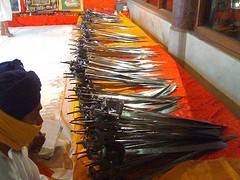
THE Akalees form one of the five great divisions of religious mendicants among the Sikhs; though they can hardly be considered mendicants in a strictly religious sense, being rather fanatical soldiers, who have become a class, than devotees like the Oodassees, Nanuk Shahees, and others, who affect a strictly religious life accompanied by severe ascetic penances. As represented in the Photograph, the Akalee is always armed to the teeth. His high conical turban, like the rest of his dress of a blue colour, is encircled by rings of sharp steel quoits, in the use of which he is very skilful. The rest of his arms are a sword and shield, a steel bow of the ancient Parthian pattern, with a brace of horse pistols, or a collection of daggers in his waistband. In this equipment the Akalee is a truly grim and formidable looking person; and in most of the fraternity there is a peculiar wildness of expression, partly owing to fanatical spirit, and partly to the habitual use of intoxicating drugs. In the former Sikh army Akalees were a prominent feature. They submitted to no discipline, but joined together in bodies, and often performed reckless feats of valour. In this respect they resemble the military Gosaens of the Hindoo classes, but the Akalees were even more fierce and uncontrollable. Since the British occupation of the Punjab they have been obliged to conform themselves to the laws, and to abandon openly lawless courses; and the practice of strutting about as " swash bucklers" has been controlled very effectually. It is only in native states, at Hyderabad in the Deccan, for instance, where the Akalees in all their pristine fierceness and defiance of order are to be met with; and their wild figures when in company with bands of their own countrymen who serve as soldiers, are always very remarkable.
The Akalees are followers of the tenth Gooroo, Govind, under whom the Sikhs became a military fraternity and nation. They were his especial body guard, and, in the beginning of Sikh fanaticism, were the most devoted of the Gooroo's followers. It is the object of the sect to keep up the tradition of this exclusive character, both general and individual; and it must be allowed that the result hitherto has been sufficiently remarkable. Akalees ma)'- eat all animal food but beef. They cannot smoke, but they drink bhang; the intoxicating quality of which produces a fierce excitement, ending in stupefaction. They do not marry. Their chief religious exercise is telling their beads and repeating the word " Akhal," or eternal, from whence their sect take its name; the greater number of repetitions the greater the supposed merit. The sect of Akalees is not so numerous as it used to be, and will probably gradually die out. From the native armies of the Punjab it received many additions in men too desperate and lawless to submit even to the lax discipline of the Sikh forces, and in the turbulent masses which composed them they often proved a dangerous and uncontrollable element. The power of the Akalees culminated after the death of Runjeet Singh, and on the bloody fields of Feroze Sheher and Soobraon the warlike fury, as it were, of the sect was spent and broken, most likely for ever. In its religious element, however, it is still strong. The order of priests which forms an influential portion of it are the possessors of the sacred shrine of Amritsur, where the holy books of the Sikh faith are deposited, and directors of the council which assembles there. The history of the Sikhs gives the result of the religious and fanatical enthusiasm by which these councils used to be guided, in the frequent foreign wars and internal dissensions of the Sikh element. Runjeet Singh was the only mind which could hold this spirit in check, and the respect of the Akalees for him was rarely violated during his long and eventful reign. It was after his death that the Akalee council became uncontrollable ; the result of which was a wild desire for the conquest of India, which led to the Sikh advance into British territory, and by a series of events to the annexation of the Punjab to British India. In Ward's work upon the Hindoo religion an interesting account of the Akalee council at Amritsur is given, a summary of which may not be out of place here, being, indeed, a quotation from Sir John Malcolm's sketch of the Sikhs.
When a Gooroo Muta or great national council is called (as it always is, or ought to be, when any imminent danger threatens the country, or any large expedition is to be undertaken), all the Sikh chiefs assemble at Amritsur. The assembly which is called Gooroo Muta, is convened by the Akalees; and when the chiefs meet upon this solemn occasion, it is concluded that all private animosities cease, and that every man sacrifices his personal feelings at the shrine of the general good. When the chiefs and principal leaders are seated, the Adee Grunth and Dushmee Padshahee Grunth are placed before them. They all bend thenheads before these scriptures, and exclaim, "Wah! Gooroojee ka khalsa! wah! Gooroojee ke futteh!" A great quantity of cakes, made of wheat, butter, and sugar, are then placed before the volumes of their sacred writings, and covered with a cloth. These holy cakes, which are in commemoration of Nanuk's injunction, to eat and give others to eat, next receive the salutation of the assembly, who then
AKALEE.
rise; the Akalees pray aloud, while the musicians play. The Akalees, when their prayers are finished, desire the council to be seated. After the cakes have been eaten in token of complete union in one cause, prayers are again said by the Akalees; after which the chiefs close together, and invoke the sacred Grunth to guide their deliberations. This moment of religious fervour and ardent patriotism is taken to reconcile all animosities. They then proceed to consider the danger with which they are threatened, to settle the best plans for averting it, and to choose the generals who are to lead their armies against the common enemy. The first Gooroo Muta was assembled by Gooroo Govind, and the last occurred in that memorable and stormy period, in which the Sikh army was hurled against the British power, and shattered in the conflict.
The Akalees of Amritsur are proud of their sacred office; and, in contrast with what they used to be, are now courteous and very hospitable, welcoming English travellers and visitors with evident respect and good-will. Among them may, however, still be seen specimens of old grim brethren, who, covered with offensive and defensive weapons, look on modern usages with contempt, and pass their existence in a condition of semi-stupefaction, under the influence of bhang.


![Reblog this post [with Zemanta]](https://lh3.googleusercontent.com/blogger_img_proxy/AEn0k_tvNuCoOpF5mr57wTQ-zY00qDUz0v-F02gmrB7MEfUK6t1xxxe-0BQZivqv7VQoVQVxudmgWsi9ox0unk9zPP0SyoL5YWAkSR8QOmyjrTd5_r5OEQpP15VwsQ7irH1wKtOk3CoyGO752WRVA_5RD8qK=s0-d)
![Reblog this post [with Zemanta]](https://lh3.googleusercontent.com/blogger_img_proxy/AEn0k_vhBRzx3R4sklt9WmZkjup30us_rrrGtE69QwWm3bflL1XTUfURWmuYJsKh02zByXI7hzLFuHtWOq_olN0DIXo_aCMtgeGEANyvX00MkfzquQgFTiEccM0hI-fGunhvoaPua8pyDKA4GDmOuJg0IAYP=s0-d)
