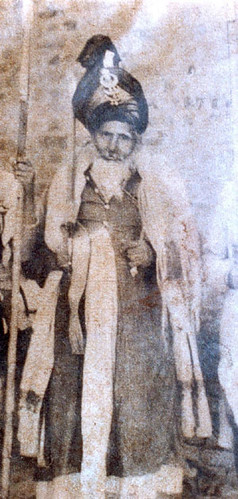
In the land of Runjeet Singh are a kind of military, spiritual Dervishes, highly respected, and revered by the nation, and even considered to be sacred. They are called Akalee, immortal. This sect was originally founded by Gooroo Govind Singh, the tenth Gooroo of the Seiks. The Seiks were formerly a spiritual people, and did not aspire to temporal power ; they were however in the habit of disturbing the peace of the country, and resisting the authority of the Mahomedan government, from the religious animosity which naturally existed between them. This led to the persecution of the sect, and in the time of Aurunghzeeb, Emperor of Delhi, the Mahomedans succeeded in seizing the Gooroo Dekht Bahadar, the 9th priest of the Seiks, who was put to death at Delhi. Gooroo Govind Singh, on his accession to the primacy, invoked the vengeance of God, to revenge this insult, and determined to prosecute a war against the Moghul. After various successes, he was defeated, and obliged to abandon his country. Those of his followers, who remained firm to him in the contest with the Moghuls, he honoured by the nomination of Akalee, or the immortal; and from that time they became a mendicant race. The Seiks became independent during the reign of Furokhseer, the Emperor of Delhi. The Akalee in. creased in number, and they are noted for their predatory and fanatical habits and impertinence. Seventy years ago, the Seiks established their authority in the Punjab. The Akalee wear a distinctive dress, of dark-blue, and a high cap, in which they generally wear iron rings, resembling a quoit, which the Seiks formerly used as an implement of war.
Thursday, 8 October 2009
Early accounts of the Akali Nihang Khalsa
In the land of Runjeet Singh are a kind of military, spiritual Dervishes, highly respected, and revered by the nation, and even considered to be sacred. They are called Akalee, immortal. This sect was originally founded by Gooroo Govind Singh, the tenth Gooroo of the Seiks. The Seiks were formerly a spiritual people, and did not aspire to temporal power ; they were however in the habit of disturbing the peace of the country, and resisting the authority of the Mahomedan government, from the religious animosity which naturally existed between them. This led to the persecution of the sect, and in the time of Aurunghzeeb, Emperor of Delhi, the Mahomedans succeeded in seizing the Gooroo Dekht Bahadar, the 9th priest of the Seiks, who was put to death at Delhi. Gooroo Govind Singh, on his accession to the primacy, invoked the vengeance of God, to revenge this insult, and determined to prosecute a war against the Moghul. After various successes, he was defeated, and obliged to abandon his country. Those of his followers, who remained firm to him in the contest with the Moghuls, he honoured by the nomination of Akalee, or the immortal; and from that time they became a mendicant race. The Seiks became independent during the reign of Furokhseer, the Emperor of Delhi. The Akalee in. creased in number, and they are noted for their predatory and fanatical habits and impertinence. Seventy years ago, the Seiks established their authority in the Punjab. The Akalee wear a distinctive dress, of dark-blue, and a high cap, in which they generally wear iron rings, resembling a quoit, which the Seiks formerly used as an implement of war.
Sunday, 9 August 2009
Akali Baba Sahib Singh Ji Kaladhari
This was written out of by the people in charge of the printing press, but not the oral history of the Khalsa Panth.
Floyd "Red Crow" Westerman: "There is an ancient Indian saying that something lives only as long as the last person who remembers it. My people have come to trust memory over history. Memory, like fire, is radiant and immutable while history serves only those who seek to control it, those who douse the flame of memory in order to put out the dangerous fire of truth. Beware these men for they are dangerous themselves and unwise. Their false history is written in the blood of those who might remember and of those who seek the truth." -spoken by Floyd Westerman
Dhan Dhan Akali Baba Sahib Singh Ji Kaladhari, who made it possible for Singhs to carry a shastar and wear blue, in the dark days of colonialism.
From a forthcoming publication..................
Salok Dumalle Da
http://kamalroopsingh.blogspot.com/2008/12/baba-fateh-singh.html
Saturday, 8 August 2009
Akali Baba Santa Singh Santhia Sarbloh Granth Sahib 2 /1 /2004
Friday, 7 August 2009
A true Saint warrior, Sant Jarnail Singh Khalsa Bhinderwale
Thursday, 6 August 2009
The Shaheedi of Akali Baba Phoola Singh Nihang 96 Crore Jathedar Shironmani Panth Khalsa Akali Buddha Dal Panjva Takht Chalda Vahir, Vishav
A British witness writes:
Its Phoola Singh who heads the band, but sure I saw him fall, When first he led his heroes on, struck by a musket-ball: Now mounted on an elephant, he leads them on again, But much I fear, five hundred men, will waste their lives in vain.
Their silence, nor their trembling looks, did that fierce chief dismay, But boldy with his gallant band, he rushed into the fray: The Afghans nothing loth came down, the fight grew fiercer still, Yet onward press the gallant few, for that contested hill.
Like hailstones rained the leaden storm, around, above, below, But yet the dauntless lessening band, press onward on the foe. Their leader on his elephant, still forward led the way, His was the guiding spirit still, above the bloody fray.
He watched his time, then gave the word, each man released his steed, adrove him through the Muslim ranks, with fury-winged speed,
Their matchlocks on the ground they threw, and drew the fierce Talvar
, And higher up that bloody hill, they bore the tide of war.
Again the Khalsa troops advance, remembering former fame; They burn to wash in Afghan blood, the morning's marks of shame.
Akali Baba Santa Singh 96 Crore Jathedar Shironmani Khalsa Panth Akali Buddha Dal Panjva Takht Chalda Vahir, Vishav.

A photograph of Baba Ji in around the 1980's when Baba Ji. In this photograph he is watching shastar-vidiya and wrestling with the Singhs.
Wednesday, 5 August 2009
Mesmerised with the world of Nihangs
Tribune News Service
Ludhiana, August 4
Today, some people see Nihangs as a relic, but others recognise them as a colourful and important part of the Punjabi heritage.
Gurbir Singh Brar, a photo artist also feels that there is no colourful subject as compared to Nihangs. Nihangs belong to a martial tradition started by the 10th Guru, Guru Gobind Singh. A photo exhibition by Brar under the theme “The Valiant Ones” was inaugurated today at Dr MS Randhawa Art Gallery, PAU.
Their way of life, style of dress, and weaponry has not changed much over the centuries and this was what capitulated Brar to spend five months with Nihangs around Punjab. During this period, he lived with them, learnt their way of living and captured them in his camera. Brar is all praise to the sense of discipline that prevails among Nihangs.
“They are very hospitable and are strict when it comes to disciple. Watching their practice session was the thing I enjoyed most during my five months stay with them all over Punjab,” adds Brar.
Brar said they are a semi-nomadic people and are organised into armies and live in camps known as cantonments. Men and women both train in horsemanship, swordsmanship, and in the Punjabi martial art known as ‘gatka’. During times of persecution in the past, the Nihangs defended Sikh shrines and the Sikh way of life and become known for their bravery against all odds.
In times of peace, they travel to festivals and fairs throughout India, staging displays of horsemanship and martial skills. The annual Hola Mohalla fair held at Anandpur Sahib on Baisakhi is especially notable for the Nihangs' colourful displays of pageantry.
Brar has also formed an organisation “Sava Lakh Foundation” with the help of Nihangs. With the active involvement of Akal College Council Gursagar Mastuana Sahib and ace horseman Maghar Singh, a training programme in traditional horsemanship and martial arts has been initiated at Mastuana Sahib.
“In today's competitive world, Sava Lakh Foundation exhorts the younger generation to live up to the ideals of the Gurus. The endeavour is to instil pride and enthusiasm in the present day youth, a youth morbidly impressed by the wrong influences and drawn towards drugs and wallowing in mediocrity,” he adds.
Monday, 3 August 2009
The black and white sing of you
ਭਖਰੀ ਕੰਧਾਰੀ ਗੋਰ ਗਖਰੀ ਗਰਦੇਜਾ ਚਾਰੀ ਪਉਨ ਕੇ ਅਹਾਰੀ ਤੇਰੇ ਨਾਮੁ ਧਿਆਈਅਤੁ ਹੈ ॥भखरी कंधारी गोर गखरी गरदेजा चारी पउन के अहारी तेरे नामु धिआईअतु है ॥